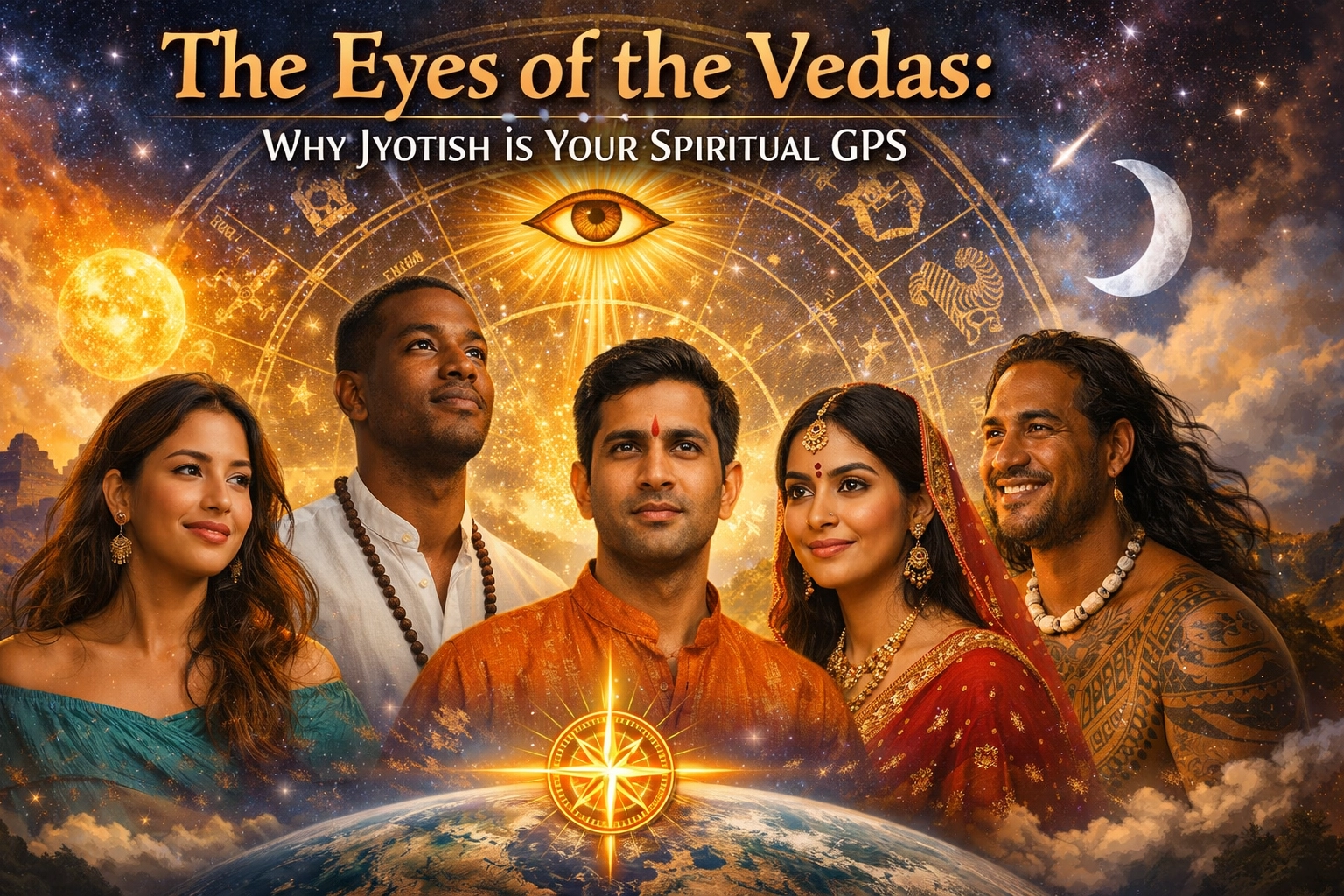
In the Vedic tradition, astrology is not a hobby and not entertainment. It is Jyotish—Vedachakṣusā—the “Eye of the Veda.”
If the Veda is śabda (authoritative revelation) preserved through disciplined transmission, Jyotish is the auxiliary science that allows that revelation to be applied in time. It is a tradition of observation and calculation: the disciplined study of luminaries, calendrics, and cycles, used to evaluate kāla (time) as a real field in which karma ripens and practice either bears fruit—or does not.
The Body of Wisdom: The Six Vedangas
To understand Jyotish, you first have to understand the Vedangas. The ancient Rishis (seers) personified the vast ocean of Vedic knowledge as a human body. For this body to function, it needs six limbs or auxiliary sciences:
- Shiksha (Nose): Phonetics and pronunciation: the breath of the Veda.
- Vyakarana (Mouth): Grammar: the structure of the language.
- Chhandas (Feet): Prosody and meter: the rhythm that allows the knowledge to walk.
- Nirukta (Ears): Etymology: understanding the origin and meaning of words.
- Kalpa (Hands): Ritual and practice: the ability to act on the knowledge.
- Jyotish (Eyes): Astronomy and astrology: the vision to see when and where to move.
A practitioner may possess sincere intent, correct recitation, and disciplined ritual execution, yet still fail when action is taken at the wrong time. Jyotish provides jyoti (light) in the strict sense: illumination of the quality of the present moment, so practice and decision are placed in a legible temporal context rather than in guesswork.

Shifting the Focus: From Prediction to Alignment
A common misunderstanding is to reduce Jyotish to “prediction.” Classical practice is better described as evaluation of kāla—time as an operative condition—and the disciplined selection of appropriate timing (muhūrta). The point is not fatalism. It is discernment: knowing when an action is supported, obstructed, or mixed, and choosing accordingly.
This is why Jyotish is paired with the rest of the Vedāṅgas. The Veda is not only text; it is application. Application requires timing. A rite performed with correct form but poor timing can be weakened; a decision made without regard for cycles can generate avoidable friction. Jyotish trains a practitioner to read temporal conditions with sobriety and to act without impatience.
The Three Pillars of Jyotish
To get a full 360-degree view of your life, Jyotish relies on three foundational pillars. If you’re only looking at your "sign," you’re missing 90% of the picture.
1. Siddhānta (Mathematics and Astronomy)
Siddhānta grounds Jyotish in computation: calendrics, planetary motion, reference frames, and the parameters required to derive a chart from measurable cycles. Without siddhāntic rigor, interpretation becomes impressionistic. Jyotish is not built on mood; it is built on repeatable calculation applied to a coherent cosmology.
2. Saṁhitā (Collective Signs and Mundane Conditions)
Saṁhitā addresses the collective domain: public events, seasonal patterns, and the reading of sign-structures in nature and society. Within that domain sits śakuna (omens), treated traditionally not as superstition, but as a discipline of correlation—training attention to notice when the environment mirrors a shift in underlying conditions.
Read properly, omens do not replace calculation. They function as corroboration and as diagnostic texture: an additional register for assessing whether a moment is stable, volatile, or transitional.
3. Horā (The Individual Chart)
Horā concerns the natal chart and its timing systems. It studies how cosmic cycles are indexed to an individual at birth and how those indices unfold through structured periods (such as daśā systems). Karma here is not moral theater. It is causality across time: tendencies, constraints, capacities, and the predictable seasons in which particular themes become activated.

Śakuna and Disciplined Correlation
Within Vedāṅga Jyotish, śakuna (omens) belongs to a larger epistemic posture: the world is intelligible, and patterns repeat across registers. Traditional sources treat omens as meaningful when read with restraint—grounded in context, corroborated by timing, and interpreted without theatricality.
The practical value is diagnostic: omens can indicate instability, obstruction, or a need to pause. They do not override chart calculation, nor do they justify paranoia. They are one part of a broader method for recognizing whether conditions are supportive, adverse, or mixed.
Developing "Trikaal Drishti": The Inner Vision
The aim of Jyotish is not fixation on planets; it is the cultivation of discernment. The tradition speaks of Trikāla Dṛṣṭi—a disciplined capacity to read continuity across past, present, and emerging future.
When temporal patterns are seen clearly, anxiety decreases and responsibility increases. One stops demanding certainty and begins practicing appropriate response. The chart does not imprison; it describes conditions. Description makes choice sharper: if a period intensifies heat, agitation, or conflict, the remedy is not denial but deliberate counterbalance through practice, restraint, and right timing.

Jyotish as Vedāṅga: Authority, Method, and Restraint
As Vedāṅga, Jyotish is defined by responsibility: careful method, textual fidelity, and interpretive restraint. It requires study of parameters and tradition, patience with computation, and humility before cycles that do not bend to preference.
In this sense, Jyotish functions as an applied eye: it does not replace effort, devotion, or ethics. It clarifies timing, identifies pressure points, and distinguishes between what can be advanced now and what must be matured. Properly held, it reduces superstition and increases accountability.
Concluding Note
Jyotish, held as Vedachakṣusā, is a discipline for seeing time—not as fantasy, not as mood, but as ordered cycles that can be calculated, interpreted, and applied with sobriety. It belongs to a scriptural ecosystem in which knowledge is not merely stated but enacted at the right time, in the right way.

To inquire about consultations or mentorship, contact Tantric Journey: https://tantricjourney.org/contact