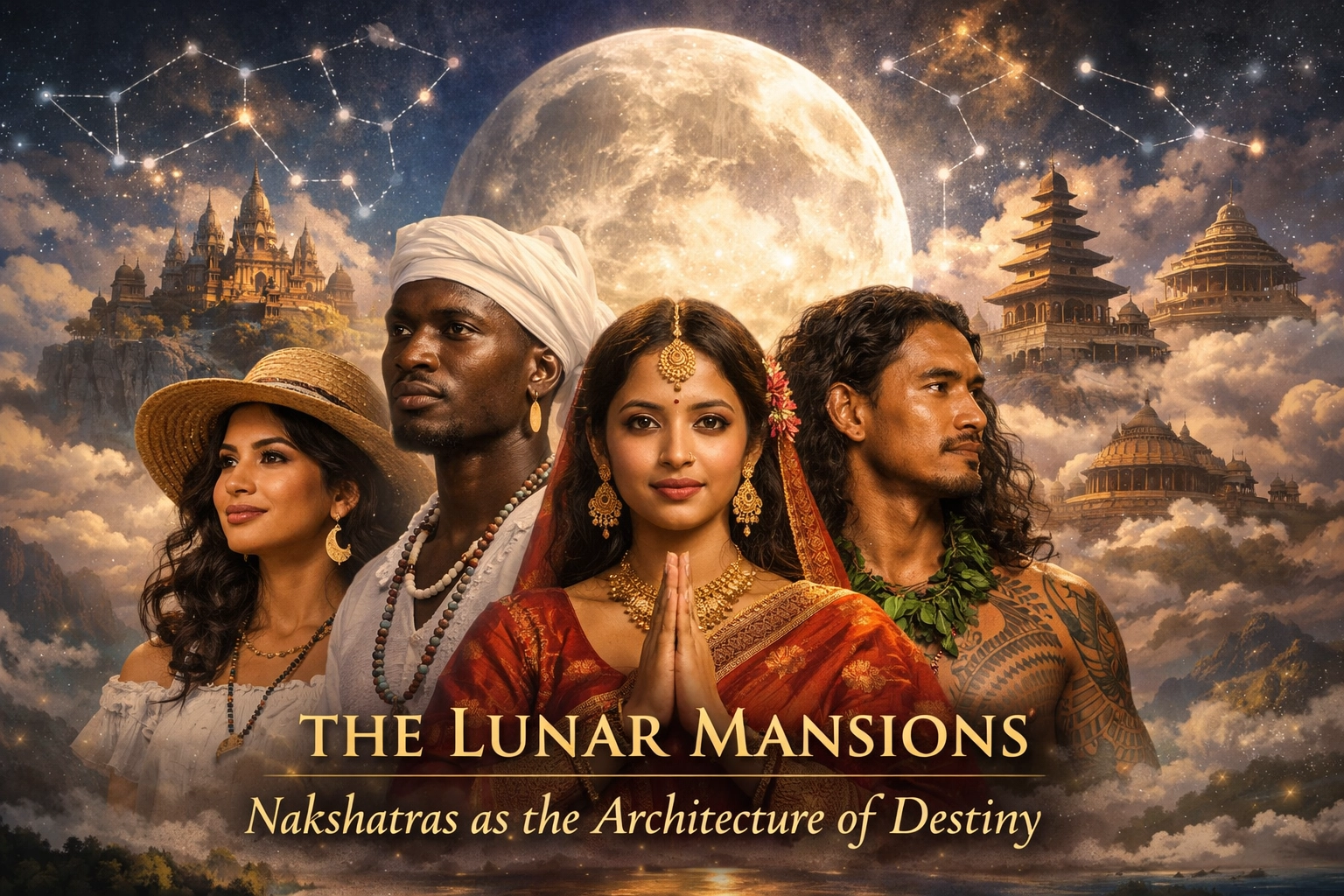
The Lunar Mansions: Nakshatras as the Architecture of Destiny

In the vast and precise science of Jyotish, the twelve signs of the zodiac, or Rashis, are often the first point of contact for the seeker. However, to stay only at the level of the Rashi is to observe the skin without understanding the nervous system. The true depth, the granular architecture of human destiny, is found within the 27 Nakshatras: the Lunar Mansions. While the Sun represents the soul’s external journey and the ego's social expression, the Moon represents the mind, the subconscious, and the vessel through which karma is filtered. To understand the Nakshatras is to understand the "cosmic clock" that governs the precise timing of events and the psychological environment in which planetary energies must operate.
The Nakshatras are not merely segments of space; they are living fields of intelligence. Each mansion represents a specific frequency, a deity, and a "Shakti": a unique power or capacity to achieve a specific result. Without this foundational knowledge, any attempt at Sadhana or spiritual discipline remains incomplete, as one is moving blindly through the celestial tides without a map of the internal terrain.
The Mythology of the Moon: The Daughters of Daksha
The origin of the Nakshatras is rooted in a profound lesson of balance and cosmic order. According to the ancient Puranas, the Moon (Chandra) was married to the twenty-seven daughters of the progenitor Daksha Prajapati. These twenty-seven daughters are the Nakshatras themselves. However, the Moon, captivated by the beauty and grace of the Nakshatra Rohini, began to neglect his other twenty-six wives, spending all his time in her mansion.

This imbalance led to a celestial crisis. Daksha, seeing the sorrow of his other daughters, cursed the Moon to suffer from a wasting disease: consumption. As the Moon began to fade, the gods intervened, recognizing that the world cannot survive without the cooling, nourishing light of the lunar energy. The curse could not be entirely lifted, but it was modified: the Moon would now wax and wane in a perpetual cycle.
This story serves as the metaphysical foundation for the Shukla Paksha (the waxing phase) and the Krishna Paksha (the waning phase). It is a reminder that the universe demands equilibrium. In our spiritual life, if we over-identify with one aspect of our nature (symbolized by Rohini) and neglect the other dimensions of our karmic responsibility, we inevitably face a "waning" of our vital force. The Nakshatras teach us that every phase of the Moon, every mansion we pass through, has a specific duty and a sacred purpose within the overarching cycle of time.
The Mathematics of the Soul: The 108 Padas
The technical sophistication of the Nakshatra system far exceeds the generalities of Western astrology. Each of the 27 Nakshatras spans 13 degrees and 20 minutes of the ecliptic. These are further subdivided into four quarters, known as Padas. Each Pada consists of 3 degrees and 20 minutes.
When we multiply the 27 Nakshatras by their 4 Padas, we arrive at the sacred number 108. This is the same number of beads on a traditional mala used for Japa, and it represents the 108 steps between the earthly consciousness and the divine sun. In Vedic tradition, the specific Pada in which the Moon is placed at the moment of birth determines the "Namaksara": the first syllable of the child's name.
This is not a matter of superstition but of vibration. The Nakshatra and its Pada act as a tuning fork for the soul's incarnation. By naming a child according to the vibration of their birth Nakshatra, we align their external identity with their internal cosmic resonance. This alignment is essential for an effective Sadhana, as it ensures that the practitioner is working with, rather than against, the natural architecture of their destiny.
Gandanta: The Dangerous Thresholds
In the journey through the zodiac, there are specific points of high spiritual tension and karmic volatility known as Gandanta points. These occur at the junctions where a water sign ends and a fire sign begins. Specifically, these are the transitions between Ashlesha and Magha, Jyeshtha and Moola, and Revati and Ashwini.

The word "Gandanta" literally translates to a "knot at the end." These points represent a structural weakness in the fabric of the soul’s journey: a place where the karmic ties are so tightly wound that they must be "unknotted," often through intense or even traumatic life experiences. In these transitions, the planet is moving from the emotional, dissolving nature of water into the transformative, purifying heat of fire. It is a spiritual void where the old identity is stripped away.
For a practitioner of Authentic Tantra, the Gandanta points are not something to be feared, but periods of profound potential for liberation. They are the "cracks" in the physical world through which one can glimpse the underlying reality. However, navigating these points requires the guidance of a Lineage and a disciplined practice, as the ego often feels it is drowning or burning during these celestial passages.
Moola: The Root and the Center of the Galaxy
Of all the Nakshatras, Moola holds a position of singular importance. Located at the very beginning of the sign of Sagittarius, Moola marks the junction of the Jyeshtha-Moola Gandanta and is associated with the deity Nirriti, the goddess of destruction and dissolution.
Modern science has confirmed what the ancient Rishis knew thousands of years ago: the direction of Moola corresponds to the Galactic Center: the "Vishnunabhi" or the navel of Vishnu. This is the gravitational and energetic heart of our galaxy. Moola means "the root." It represents the power to uproot perceived reality to find the core truth.

While many fear Moola because of its association with loss and destruction, in the context of spiritual evolution, it is the most vital mansion. It represents the destruction of the "maya" (illusion) that keeps the soul bound to the cycle of rebirth. To work with the energy of Moola is to face the void, to go to the root of one's desires and fears, and to emerge with a realization of the Absolute. It is the ultimate Nakshatra for those committed to a path of serious Sadhana.
Nakshatras as the Environment for Planetary Energy
A common mistake in modern "pop" approaches to spirituality is to view a planet's placement in isolation. A planet is like a person, but the Nakshatra is the room in which that person stands. If Mars is in the Nakshatra of Bharani (ruled by Yama, the god of death), its energy will be focused on transformation, restraint, and the cycle of birth and death. If Mars is in Rohini (ruled by Brahma), that same planetary energy becomes creative, productive, and focused on growth.
Understanding these environments allows the practitioner to tailor their Sadhana to the specific "Shakti" available to them. For example:
- Ashwini: The power to reach things quickly (healing).
- Krittika: The power to burn away impurities (purification).
- Pushya: The power to create spiritual luster (nourishment).
- Magha: The power to leave the body (ancestral connection).
By recognizing the specific Shakti of the lunar mansion, the practitioner moves from a state of reactive living to a state of conscious participation in the divine decree.
Conclusion: The Path of Authentic Alignment
The study of Jyotish and the Nakshatras is not intended for mere fortune-telling. It is a sacred map provided by the Lineage to help the soul navigate the complexities of human incarnation. By understanding the Nakshatras as the architecture of destiny, we stop fighting the tides of time and begin to flow with the cosmic pulse.
True spiritual progress requires us to look beyond the surface level of signs and symbols. We must engage with the deep vibrations of the lunar mansions, acknowledging the cycles of waxing and waning, the intensity of the Gandanta points, and the profound silence of the Galactic Center in Moola. This is the path of the serious seeker: one who seeks not just comfort, but the truth of their existence within the grand design of the universe.
For those ready to move beyond superficial understandings and engage in the disciplined work of transformation, the Nakshatras offer the most precise tools available in the Vedic tradition. It is through this alignment that the individual soul finds its way back to the universal source.
Are you ready to stop skimming the surface and dive into the depths of authentic practice? Join us at Tantric Journey to begin your path toward true spiritual discipline.